
For over two decades, Oxford United fans have endured the “three-sided” reality of the Kassam Stadium—a ground they don’t own, facing an uncertain future. But that is all about to change.
The club’s move to the Triangle in Kidlington isn’t just a relocation; it is a £150 million architectural statement that is set to become the most sustainable football stadium in the United Kingdom.
From being on the brink of “homelessness” to designing a world-class, 16,000-capacity all-electric venue, the U’s are setting a new benchmark for British football infrastructure.
In this deep dive, we go inside the plans for the new Oxford United stadium, exploring its groundbreaking eco-technology, the return of the iconic Manor Ground arch, and what this move means for the future of the Championship.
The Kassam Crisis: Why Oxford United Need New Stadium?
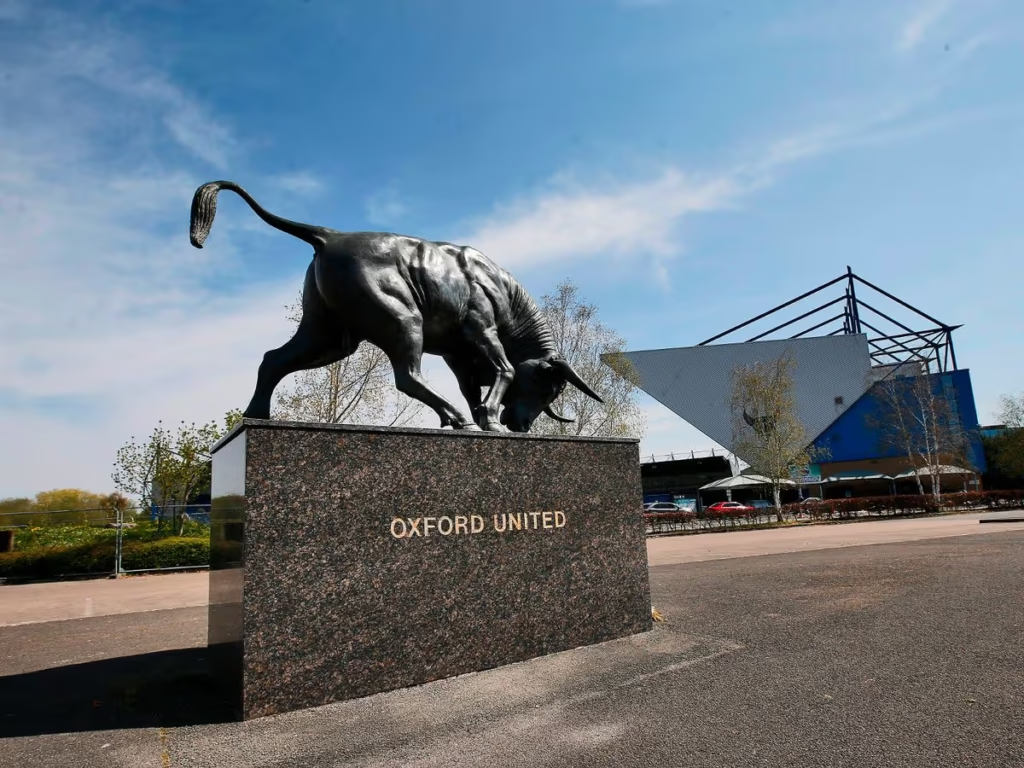
To understand the magnitude of this project, you have to look at what Oxford United fans have endured since 2001.
The Kassam Stadium was never truly “finished.” To save costs during a period of financial instability, the fourth stand—the one behind the southern goal—was simply never built.
For a quarter of a century, the team has played every home match facing a fence with a Hollywood Bowl bowling alley as the backdrop.
More importantly, the club never owned the ground. The lease with the Firoka Group was a ticking clock.
With the original agreement set to expire in 2026, the club faced a genuine existential crisis.
CEO Tim Williams admitted publicly that there was a real possibility of a Championship club becoming homeless.
The answer? The Triangle.
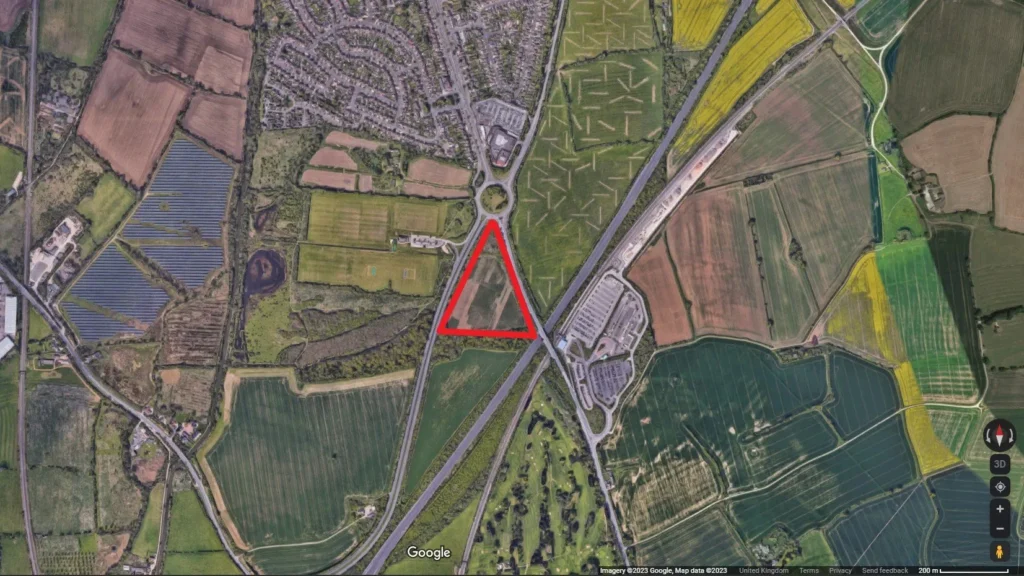
After surveying 64 different sites across the region, the club identified a five-hectare plot in Kidlington as the foundation for their future.
Oxford United New Stadium Location
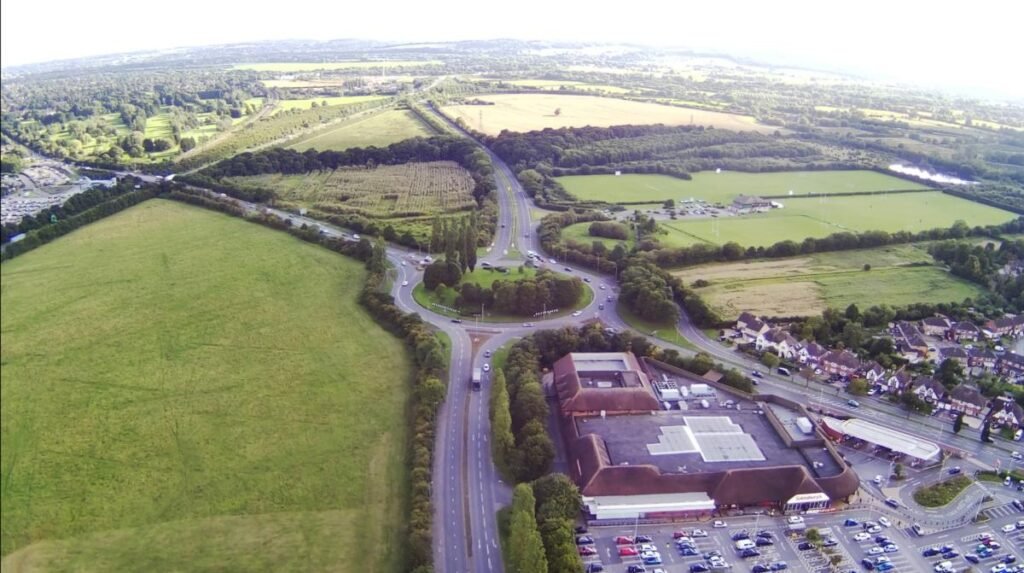
The move to the Triangle isn’t just about finding space; it’s about smart urban planning.
- Rail Superiority: The site sits adjacent to Oxford Parkway station, with plans for a dedicated footbridge connecting the platform directly to the stadium. With the East West Rail link now operational, Oxford United will boast one of the most accessible grounds in the country.
- Infrastructure Investment: To address local concerns, the club committed £5.1 million to the community via a Section 106 agreement. This funds improvements to bus services, the reopening of the Cowley Branch Line, and a new “mobility hub.”
Planning Milestones
In February 2026, after four years of consultations and navigating Secretary of State reviews, the project reached a historic milestone: full and final planning permission.
While local opposition groups raised concerns regarding the green belt, the club’s commitment to biodiversity and infrastructure ultimately cleared the path for construction.
Architecture with a Purpose: AFL Architects and the “Optimized Bowl”
The design team behind the project is AFL Architects, the same firm that designed the Lusail Stadium for the 2022 FIFA World Cup Final. They aren’t just building a box; they are building an atmosphere.
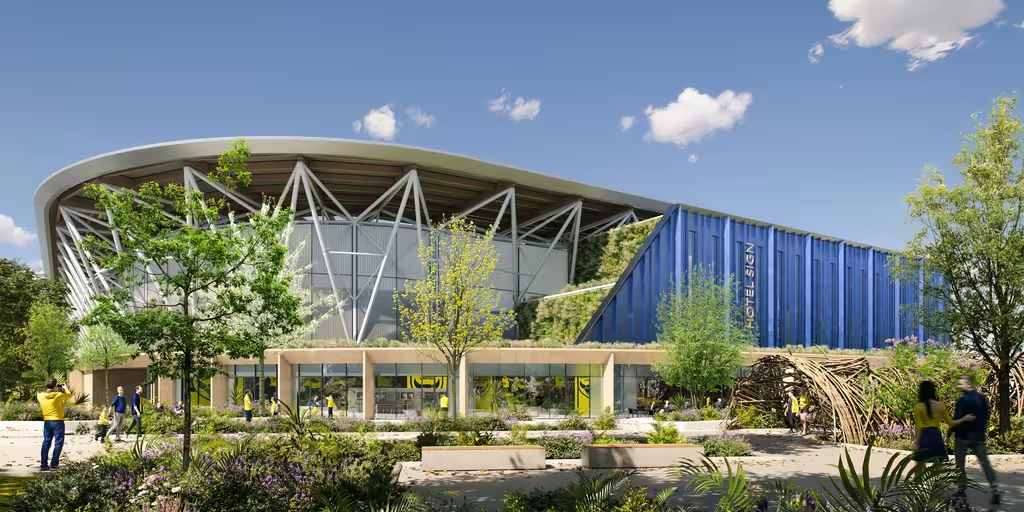
A Continuous Sweep
Unlike the Kassam, this stadium is a fully enclosed, continuous bowl. The rake (the steepness of the seating) is sharper than typical Championship standards. This compresses sightlines, bringing fans closer to the action and trapping the noise inside the ground.
Oxfrod United New Stadium Design Responsive to Nature
One of the most striking features is the sloped roof. It rises toward the North-West to accommodate an integrated hotel and tapers down toward the South-East to blend into the existing woodland.
Even the orientation is calculated: the West Stand is positioned so the sun sets behind it during a 3pm kick-off, protecting the vision of players and fans alike.
The Return of the Arch
In a nod to the club’s heritage, the Oxford Road entrance will feature a rectangular gate. This is a modern reinterpretation of the famous arched entrance to the Manor Ground, the club’s home from 1925 to 2001. It is a quiet, powerful act of historical respect for the supporters.
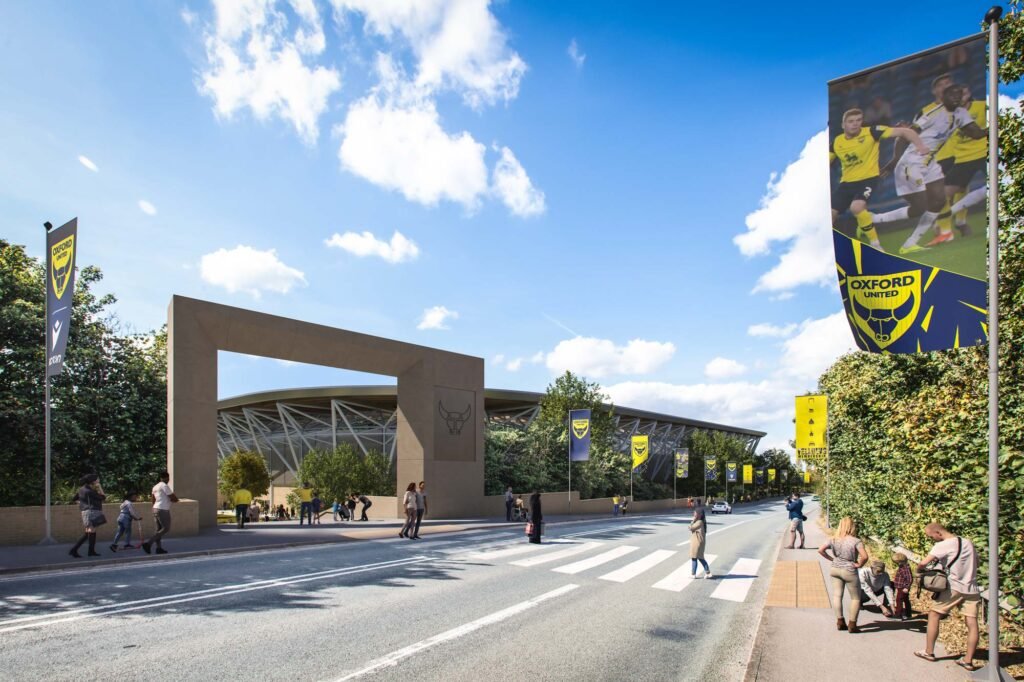
A New Standard for Inclusivity and Capacity
The new stadium boasts a capacity of 16,000, a 28% increase over the Kassam.
- Safe Standing: 25% of the bowl will feature rail seating, allowing fans the choice to stand safely.
- Elite Accessibility: Praised by Baroness Tanni Grey-Thompson, the design includes 130 dedicated wheelchair spaces, step-free access, and a state-of-the-art sensory room. This isn’t just about meeting regulations; it’s about being the most inclusive stadium in the UK.
The UK’s First All-Electric Stadium
This is the headline that is shifting the industry: Oxford United’s new home will be the first entirely electric-powered football ground in the United Kingdom.

While other clubs talk about “net-zero by 2040,” Oxford is building the infrastructure to achieve it from Day One.
- Solar Power: 3,000 square metres of photovoltaic panels on the roof.
- Air-Source Heat Pumps: Removing gas from the system entirely.
- 80% Reduction in CO2: Compared to gas-heated stadiums of equivalent size, this facility will slash emissions by four-fifths.
The surrounding landscape, designed by Fabrik, includes beehives, ponds, and wildflower meadows, targeting a minimum 10% net biodiversity gain.
A 365-Day Destination
Oxford United is moving away from the “matchday-only” model. The £150 million investment includes:
- Radisson Hotel: A 180-bedroom hotel integrated into the stadium structure.
- Events Centre: A 1,000-person capacity space for conferences and community use.
- A Permanent Home for Women’s Football: Oxford United Women’s Team will finally have their own dedicated home ground.
- Health & Wellbeing: A gym, restaurant, and community plaza to serve the Kidlington and Oxford regions year-round.
Current Status Of Oxford United New Stadium: When Will the First Ball Be Kicked?
As of April 2026, the project is in the enabling works and site preparation phase. With the Section 106 agreement signed and planning permission in hand, the club is targeting the 2027/28 season for the stadium’s grand opening.
In the meantime, a bridging extension at the Kassam ensures the club has a place to play until the new “house” is ready.
Oxford United are doing it the hard way—self-financing and fighting through years of planning—but the result will be a benchmark for every mid-sized club in Europe.
The Manor Ground arch is coming back, the Hollywood Bowl is staying behind, and at the Triangle, something genuinely legendary is rising.
What do you think?
Is a 16,000-capacity stadium the right size for Oxford United’s Championship ambitions, or should they have aimed higher? And how do you feel about the return of the iconic Manor Ground arch?
Drop your thoughts in the comments below and don’t forget to share this post with fellow U’s fans!